
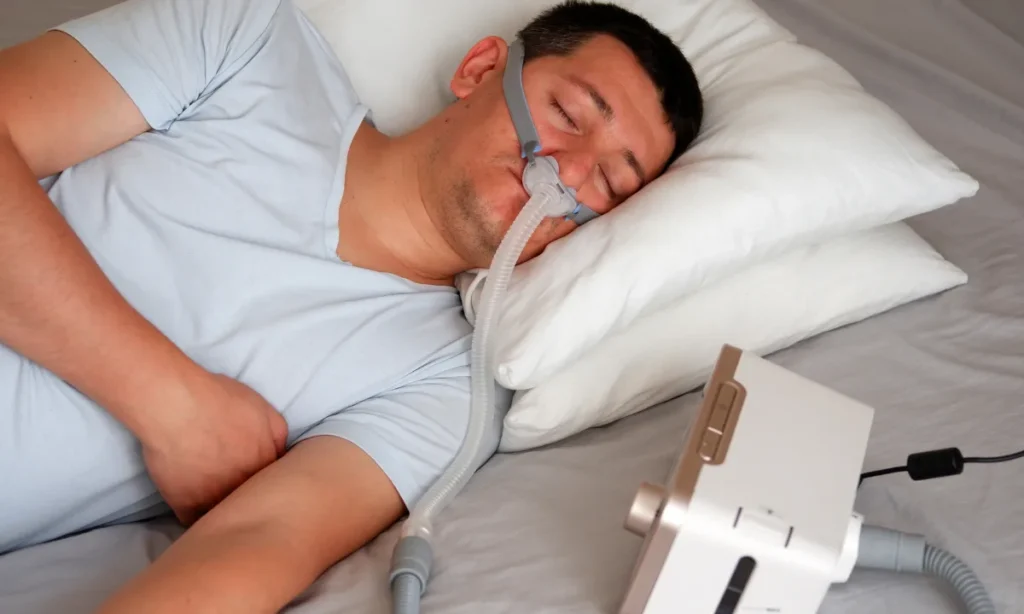
Living with obstructive sleep apnoea can mean more than loud snoring. Repeated airway obstruction during sleep can leave you waking unrefreshed, struggling with daytime tiredness, headaches, poor concentration, or interrupted sleep. Once sleep apnoea has been diagnosed, one of the biggest questions is whether CPAP or an oral appliance is the better treatment. Continuous Positive Airway Pressure (CPAP) generally gives stronger control of obstructive breathing events, while a custom mandibular advancement splint (MAS) can be an effective option for suitable patients, including some people who have difficulty using CPAP. The right choice depends on your sleep study results, OSA severity, oxygen levels, comfort with treatment, oral health, jaw function, and how well the chosen therapy controls your condition.
CPAP and oral appliance therapy have the same broad goal: keeping the upper airway open during sleep so breathing is less likely to become obstructed. They achieve this in very different ways. CPAP uses positive air pressure delivered through a mask, while a mandibular advancement appliance changes the position of the lower jaw to support the airway. This difference affects effectiveness, comfort, portability, side effects, maintenance, and which patients are likely to be suitable for each treatment.
| Factor | CPAP | Oral Appliance / MAS |
| How it works | Uses pressurised air to support the airway | Holds the lower jaw forward to support airway space |
| Main equipment | Machine, mask and tubing | Custom dental appliance |
| Effect on AHI | Generally produces greater reduction in obstructive events | Can significantly improve OSA in suitable patients, but response varies |
| Mask required | Yes | No |
| Electricity required | Yes during treatment | No |
| Portability | Requires more equipment | Small and easy to carry |
| Common problems | Mask leaks, dryness, congestion, pressure discomfort | Jaw soreness, tooth tenderness, saliva changes, bite changes |
| Monitoring | Sleep physician or CPAP provider | Dentist plus sleep-medicine follow-up |
| Common role | Effective across a broad range of OSA severity | Often considered for mild to moderate OSA or CPAP intolerance |
So, which is better: CPAP or an oral appliance for sleep apnoea? CPAP generally provides stronger physiological control of obstructive sleep apnoea, particularly when it is used consistently. An oral appliance can still be a useful treatment for appropriately selected patients, especially when CPAP is difficult to tolerate or a sleep physician considers oral appliance therapy suitable. The best treatment is the clinically appropriate one, used consistently, and shown to control your OSA.
Understanding the difference between the two treatments starts with understanding obstructive sleep apnoea. In OSA, the upper airway repeatedly narrows or collapses during sleep. CPAP prevents that collapse with air pressure, while an oral appliance changes jaw position to improve airway stability. Understanding the causes of sleep apnoea can help explain why the upper airway repeatedly narrows or collapses during sleep. Neither treatment should simply be chosen because one looks easier to use; the mechanism needs to match the patient’s diagnosis and treatment needs.
Continuous Positive Airway Pressure, usually shortened to CPAP, uses a bedside machine connected to a mask through tubing. The machine sends a continuous stream of pressurised air through the mask while you sleep. This positive airway pressure acts like an air splint, helping stop the throat and upper airway from collapsing during breathing. Depending on the equipment, a person may use nasal pillows, a nasal mask, or a full-face mask, and a humidifier may be added to reduce dryness. CPAP is highly effective when the pressure is appropriate and the device is worn consistently. The challenge for some people is adapting to sleeping with a mask, airflow, tubing, or pressure. Good mask fitting, humidification, pressure adjustments, and support from a CPAP provider can sometimes solve these problems without changing treatment.
An oral appliance for sleep apnoea is commonly called a Mandibular Advancement Splint (MAS) or Mandibular Advancement Device (MAD). Another term you may see is Mandibular Repositioning Appliance (MRA). The appliance fits over the teeth and holds the mandible, or lower jaw, in a more forward position during sleep. This change in jaw position can help support the tongue and surrounding soft tissues so there is more space in the upper airway and less chance of obstruction. The amount of mandibular advancement matters. Moving the jaw farther forward is not automatically better. A professionally fitted appliance can be gradually adjusted so the treating dentist can balance airway benefit with jaw, tooth, and bite comfort. Current dental sleep medicine standards include proper examination, appliance selection, fabrication, calibration, side-effect management, and long-term follow-up as important parts of oral appliance care.
A mandibular advancement appliance may look similar to a mouthguard, but it has a different purpose. A sports mouthguard protects teeth from impact, while a nightguard for bruxism is mainly used to protect teeth from grinding or clenching. A sleep apnoea appliance is made to position the lower jaw in a way that helps maintain airway space during sleep. Custom fit also matters. The Sleep Health Foundation recommends a device specifically fitted by a dentist rather than relying on a generic over-the-counter product, because mouth and jaw anatomy differ from person to person. Dental impressions or digital scans, bite assessment, appliance fitting, adjustment, and follow-up all form part of professionally managed oral appliance therapy.
The effectiveness question should not be reduced to a simple winner and loser. CPAP generally produces a greater reduction in obstructive respiratory events than oral appliance therapy. However, treatment success also depends on whether the therapy is used regularly, whether the patient responds to it, and whether follow-up shows that the OSA is adequately controlled.
The Apnoea-Hypopnoea Index (AHI) is commonly used to describe the frequency of apnoeas and hypopnoeas during sleep. An apnoea is a pause in airflow, while a hypopnoea is a significant reduction in airflow. The number of these respiratory events per hour helps clinicians assess OSA severity and treatment response. CPAP can be very effective at preventing upper-airway collapse because it continuously supports the airway while it is being worn. Oral appliances can also reduce respiratory events, but the level of AHI reduction varies between patients. This is one reason a reduction in snoring alone should not be treated as proof that OSA has been fully controlled.
AHI is important, but it is not the only information that matters. Sleep clinicians may also consider oxygen saturation, oxygen desaturation, daytime sleepiness, sleep quality, symptoms, and the wider clinical picture. Repeated airway obstruction can disturb sleep and contribute to fatigue, morning headaches, reduced concentration, and daytime sleepiness. Both CPAP and an effective mandibular advancement appliance can reduce snoring and improve sleep-related symptoms in suitable patients. Still, feeling better does not necessarily mean every obstructive breathing event has disappeared. If an oral appliance is being used to treat diagnosed OSA, clinical follow-up is important to assess whether treatment is doing enough.
There is an important difference between treatment efficacy and treatment adherence. Efficacy describes how well a treatment controls OSA while it is being used properly. Adherence describes how consistently the person actually uses that treatment. CPAP may provide very strong physiological control, but that benefit depends on regular use. Oral appliance therapy also depends on consistent nightly use. This is why treatment decisions should consider more than AHI reduction alone. A treatment that performs well in a sleep study but is rarely used will not provide its intended benefit throughout the nights it is left unused. At the same time, better comfort does not make a treatment clinically sufficient if significant OSA remains. Effective treatment needs both adequate control and consistent use.
Treatment suitability depends on more than preference. A sleep study, OSA severity, oxygen findings, symptoms, medical factors, jaw anatomy, teeth, gums, and the patient’s ability to use a treatment consistently can all influence the decision. Australian Sleep Health Foundation guidance describes oral appliances as commonly used for mild to moderate OSA or for people unable to use CPAP, while CPAP may be a better option where stronger OSA control is required.
Sleep apnoea is often described as mild, moderate, or severe using results from a sleep study, including AHI. Those labels are useful, but treatment should not be selected from severity alone. Symptoms, oxygen desaturation, other health issues, anatomy, treatment response, and professional assessment can change what is appropriate for an individual. For someone with mild OSA, a mandibular advancement splint may be considered where clinically suitable. In moderate OSA, both physiological effectiveness and the person’s ability to use treatment consistently become important. In severe OSA, strong control of obstructive breathing events is especially important, so a person should not replace prescribed CPAP with an oral appliance without discussion and reassessment by the relevant treating professionals.
Some people find CPAP difficult because of mask discomfort, claustrophobia, dry mouth, nasal congestion, air leaks, pressure discomfort, or difficulty adapting to the equipment. These issues do not always mean CPAP has failed. Changing mask style or fit, using humidification, reviewing settings, or getting support from a CPAP provider may improve tolerance. If CPAP remains difficult despite appropriate support, oral appliance therapy may become part of the discussion. Clinical practice guidance supports oral appliances for adults with OSA who are intolerant of CPAP or prefer an alternative, provided the treatment is appropriately prescribed and professionally managed.
Being unable to tolerate CPAP does not automatically mean a mandibular advancement device will be suitable. An oral appliance applies forces to the teeth and changes the position of the lower jaw each night, so the dentist needs to assess teeth, gum and periodontal health, bite, existing dental work, jaw movement, and temporomandibular joint function before treatment. Other clinical factors can also affect the likelihood of response. The Sleep Health Foundation notes that oral appliances tend to work better in some people with mild to moderate OSA and can be more successful where OSA improves when sleeping on the side. These are useful clues, but they cannot predict an individual’s result with certainty.
Comfort matters because sleep apnoea treatment usually needs to be used regularly over the long term. CPAP and oral appliances have different adjustment periods and different side-effect profiles. The aim is not to find a treatment with zero inconvenience, but one that provides adequate control while remaining practical enough for consistent use.
CPAP requires sleeping with a mask connected to a machine. Some people adapt quickly, while others experience mask leaks, dry mouth, nasal dryness, congestion, pressure discomfort, or difficulty getting used to the airflow. A humidifier, better mask fitting, or changes to equipment can often improve comfort. Modern CPAP systems also offer different mask styles, so difficulty with one mask does not necessarily mean every CPAP setup will feel the same. Regular use is important. Taking frequent nights off can allow untreated OSA symptoms to return, which is why CPAP problems should usually be discussed with the treating sleep team or equipment provider rather than solved by simply stopping treatment.
An MAS does not require a mask, tubing, machine, or airflow. It sits over the teeth and keeps the jaw in its prescribed position. During the early adjustment period, some patients may notice jaw discomfort, tooth tenderness, extra saliva, dry mouth, or morning stiffness. Many early symptoms may settle, but persistent pain or changes in function need professional review. Long-term use can also affect the bite or tooth position in some patients. This is why follow-up with the dentist matters even if the appliance still feels comfortable. Dental reviews can identify occlusal changes, tooth movement, jaw-joint symptoms, appliance wear, or fitting problems before they become harder to manage.
For travel and everyday portability, an oral appliance has an obvious practical advantage because it is compact and does not require electricity, tubing, or a bedside machine. This can be useful for frequent travellers, people who camp, shift workers, or anyone who regularly sleeps away from home. CPAP can still be travelled with, and portability alone should never determine medical treatment. If CPAP is providing effective control of moderate or severe OSA, leaving it at home simply because another option is smaller may leave the condition inadequately treated. Convenience should support a clinically appropriate treatment, not replace that requirement.
People often search for an oral appliance because they want an alternative to CPAP. For some patients, changing treatment can be appropriate. For others, improving CPAP tolerance may be safer and more effective. A decision to switch should consider the original sleep study, current OSA severity, oxygen findings, dental suitability, and how treatment effectiveness will be checked afterward.
An oral appliance can replace CPAP for some appropriately selected people, but it is not a direct substitute for every patient. People with diagnosed OSA should discuss a change in treatment with their sleep clinician, particularly where OSA is moderate or severe or significant oxygen desaturation has been identified. If oral appliance therapy is chosen, the goal is not simply to make snoring quieter. The goal is to manage obstructive sleep apnoea adequately while maintaining acceptable dental and jaw health. Follow-up is therefore part of the treatment rather than an optional extra.
If CPAP is uncomfortable, first identify the reason. A leaking mask, nasal dryness, unsuitable mask style, or pressure-related problem may be correctable. If those issues are addressed and CPAP is still not practical, a sleep physician may discuss other treatment options, which can include oral appliance therapy for appropriate patients. The next step is a dental assessment. The dentist can check whether the teeth, gums, bite, and jaw are suitable for a mandibular advancement appliance and, where appropriate, provide and adjust the device. Sleep-medicine follow-up remains important because dental comfort alone cannot show whether OSA has been adequately treated.
Combination therapy may be considered in selected cases rather than treating CPAP and oral appliances as mutually exclusive options. For example, mandibular advancement and positive airway pressure have been studied together when clinicians are trying to improve treatment effectiveness or tolerance. This is an individual clinical strategy, not a standard approach for every person with sleep apnoea. Any combined treatment should be planned and monitored by the appropriate sleep and dental professionals.
Oral appliance therapy is a clinical process rather than simply purchasing a device. Current dental sleep medicine standards emphasise proper assessment, appliance selection, fabrication, calibration, management of side effects, long-term follow-up, and collaboration between dentists and physicians.
Loud snoring, gasping during sleep, morning headaches, daytime fatigue, and witnessed breathing pauses can raise concern about OSA, but symptoms alone do not establish the diagnosis. Assessment commonly involves a sleep physician or sleep specialist and may include an overnight sleep study performed at home or in a sleep laboratory. It is also important to distinguish obstructive sleep apnoea from central sleep apnoea. OSA involves physical obstruction or collapse of the upper airway. Central sleep apnoea occurs when normal breathing signals from the brain are disrupted. A mandibular advancement appliance works on the airway and is therefore mainly relevant to obstructive sleep-disordered breathing rather than central sleep apnoea. If loud snoring is affecting sleep, knowing practical ways to stop snoring can also help identify when the problem may need further assessment.
Once oral appliance therapy is being considered, a dental examination helps determine whether the mouth can safely support the appliance. The assessment may include the teeth, gums, periodontal health, existing restorations, bite or occlusion, jaw movement, and temporomandibular joints. This step matters because the appliance sits on the teeth and keeps the mandible forward for many hours each night. Existing dental or jaw problems may need attention before treatment, and some patients may require a different approach. Current AADSM standards identify comprehensive examination as a key part of oral appliance care.
If the patient is suitable, dental impressions or digital scans and bite information are used to create an appliance that fits the individual’s teeth and jaw. A custom appliance can then be set to an appropriate mandibular position rather than relying on a fixed, generic fit. At Park St Dental Practice in Mona Vale, the dental team provides custom-fitted mandibular advancement splints as part of its snoring and sleep apnoea care. The practice also states that it works with patients and their sleep physician where required, which allows the dental part of treatment to sit within the broader OSA care pathway.
The first setting of an oral appliance is not necessarily its final therapeutic position. The device may be progressively adjusted, a process often described as titration or calibration, to find a jaw position that provides useful airway support without creating unnecessary tooth, muscle, or joint discomfort. This is why professionally managed oral appliance therapy is different from buying an anti-snoring mouthpiece and wearing it without review. The fit, advancement setting, comfort, dental condition, and response to treatment all need attention.
A partner reporting less snoring can be encouraging, and the patient may notice better sleep or improved daytime energy. However, those changes cannot always show whether respiratory events and oxygen changes have been adequately controlled. For diagnosed OSA, the treating team may recommend further assessment or sleep testing after the appliance has been adjusted to an effective and comfortable position. This allows treatment success to be judged using objective sleep information as well as symptoms.
Oral appliance therapy needs ongoing dental care because tooth position, bite, jaw comfort, gum health, and appliance fit can change over time. An appliance can also wear, become loose, or need further adjustment. If snoring returns, daytime tiredness comes back, the appliance starts falling out during sleep, or the bite feels different, the device should be reviewed rather than assuming it has simply reached the end of its useful life. The Sleep Health Foundation specifically recommends ongoing dental follow-up to identify problems and assess the appliance.
Cost should be considered across the life of the treatment rather than from the initial purchase price alone. CPAP has the cost of the machine and ongoing equipment, while a custom oral appliance includes professional dental assessment, fabrication, adjustment, and follow-up. Exact fees can vary between providers and individual treatment needs, so current costs should be confirmed before treatment begins.
CPAP costs may include the machine, mask, tubing, filters, humidifier components, replacement parts, and ongoing maintenance. Different machine and mask types can have different prices, and parts that wear over time may need to be replaced. Because correct fit and settings can affect both comfort and adherence, choosing equipment based only on the lowest initial price may not give the best long-term result.
The cost of oral appliance therapy can include the dental consultation, examination, scans or impressions, bite registration, custom appliance fabrication, fitting, titration, follow-up visits, and eventual repair or replacement. This makes a custom MAS different from a generic mouthguard purchased as a single retail item. Part of the cost relates to professional assessment and monitoring, which are important because the appliance changes jaw position and can affect the teeth and bite over time.
Medicare and private health benefits can differ according to the service being provided, the patient’s eligibility, and the level of cover. Sleep studies and dental appliances are also different types of healthcare services, so coverage for one does not automatically mean coverage for the other. Before treatment, patients should confirm expected fees and ask their health fund directly about relevant benefits or rebates. Avoid assuming that a particular appliance or consultation will automatically be covered.
The treatment decision becomes easier when each option is matched to the clinical problem rather than judged on convenience alone. OSA severity, oxygen findings, treatment tolerance, oral health, and confirmed treatment response should carry more weight than whether a device looks easier to use.
| Situation | What Should Be Considered |
| Suspected but undiagnosed sleep apnoea | Obtain appropriate medical assessment and sleep testing |
| Mild OSA | Symptoms, sleep findings, anatomy, preference and oral-appliance suitability |
| Moderate OSA | AHI control, oxygen findings, adherence and individual treatment response |
| Severe OSA | Strong control of breathing events and specialist-guided treatment planning |
| CPAP works and is well tolerated | Continuing effective CPAP may make sense |
| CPAP remains intolerable | Review the cause and discuss appropriate alternatives |
| Frequent travel | An oral appliance may offer practical benefits if it is clinically suitable |
| Gum or dental problems | Dental health should be assessed before MAS treatment |
| TMJ or bite concerns | Careful assessment and monitoring are required |
| Snoring improves with MAS but OSA control is unknown | Treatment effectiveness may need objective reassessment |
Three questions are especially useful when discussing your options with a sleep physician and dentist:
For people in Mona Vale and Sydney’s Northern Beaches, oral appliance therapy may provide another treatment path if obstructive sleep apnoea has been diagnosed and a mandibular advancement splint is considered appropriate. Dental suitability still matters, and people who are struggling with CPAP should not assume that changing treatments is automatically the right answer.
Park St Dental Practice provides snoring and sleep apnoea treatment in Mona Vale, including custom-fitted mandibular advancement splints. Their dental team assesses oral and jaw factors, creates and fits the appliance where appropriate, monitors progress, and works with a sleep physician when required. If you have already been diagnosed with OSA or are having difficulty using CPAP, a consultation can help establish whether an oral appliance is a suitable option for your individual situation.
An ordinary sports mouthguard or grinding guard is not the same as an oral appliance made for OSA. A mandibular advancement device is specifically fitted and positioned to hold the lower jaw forward during sleep. The Sleep Health Foundation recommends professionally fitted oral appliances rather than generic over-the-counter devices for treating OSA.
A mandibular advancement appliance can also be used for primary snoring in suitable adults. However, loud or persistent snoring can sometimes occur with obstructive sleep apnoea. If snoring is accompanied by gasping, choking, witnessed breathing pauses, morning headaches, or daytime sleepiness, assessment for OSA should come before treating the noise alone.
Bruxism does not automatically rule out oral appliance therapy, but teeth grinding can affect the appliance, teeth, jaw muscles, and bite. A dentist needs to assess the pattern and severity of grinding along with the patient’s dental condition before deciding which appliance design is appropriate.
Crowns, implants, bridges, missing teeth, and other dental work do not create one universal yes-or-no answer. A mandibular advancement splint relies on the teeth and oral structures for fit and retention, so the dentist needs to assess whether existing restorations and remaining teeth can safely support the appliance. A clinical dental examination is therefore an important part of treatment planning.
An oral appliance should continue to be reviewed after fitting because jaw comfort, bite, tooth position, gum health, appliance condition, and treatment response can change. The exact review schedule depends on the patient and clinical situation. If snoring or daytime tiredness returns, the bite changes, jaw pain develops, or the appliance becomes loose or damaged, it should be checked rather than waiting for the next routine visit.
Dr Neda Gorji
Principal Dentist | Implant Dentist
Park St Dental Practice | Dental Implant Centre
Mona Vale, Northern Beaches, Sydney