
All-on-4 dental implants can feel secure, strong, and much closer to natural teeth than removable dentures, but many patients still ask one honest question before or after treatment: does food get stuck under All-on-4 dental implants? The answer is yes, food can sometimes collect under the fixed dental implant bridge, especially around the gum line or in the small cleaning space beneath the bridge. That does not automatically mean something is wrong. In many cases, it simply means the bridge needs regular cleaning with the right tools. But if food keeps getting trapped, smells bad, causes bleeding, or feels impossible to remove, it is worth booking an implant review.
At Park St Dental Practice in Mona Vale, we help patients understand the daily care that comes with full-arch dental implants. We want patients to feel confident eating, speaking, smiling, and cleaning their new teeth. If you already have an implant bridge or are thinking about All-on-4 dental implants, this guide explains why food can get trapped, how to clean under the bridge, and when to see an implant dentist.
Yes, some food under All-on-4 dental implants can be normal. A fixed dental implant bridge usually sits slightly above the gum line, leaving a small hygienic gap so you can clean around the implant posts and gum tissue. This space is important because plaque, food debris, and bacteria need a way to be removed during daily cleaning.
Food trapping becomes a concern when it happens after almost every meal, is hard to clean out, causes a foul taste, leads to bad breath, or comes with bleeding, swelling, pain, or bridge movement. Your implant bridge should feel stable, comfortable, and cleanable. If it does not, we recommend having it checked rather than guessing at home.
Key points to remember:
Food can get stuck under All-on-4 dental implants because the implant bridge has a different shape from natural teeth. Natural teeth come through the gums one by one, while an All-on-4 restoration replaces a full arch of teeth with a fixed bridge supported by implant posts. The shape, gum line, healing changes, and cleaning space all affect how food moves during chewing. This does not mean full-arch dental implants are poor treatment. It means they need a proper cleaning routine. Once you understand why food gets trapped, it becomes easier to manage.
A full-arch dental implant bridge is not sealed flat against the gums. There is usually a small hygienic gap between the bridge and the gum tissue. This space allows you to clean under the bridge and around the implant posts. If the bridge sat too tightly against the gums, bacteria and plaque could collect in areas that are almost impossible to clean.
The hygienic gap is there for a reason. It supports daily oral hygiene and helps reduce bacteria build-up around the implant areas. The challenge is that this same space can also allow small food particles to enter. This is why tools such as a water flosser, X-Floss, bridge floss, or interdental brushes may be recommended.
After extractions and implant placement, the gums and jawbone go through a healing process. Swelling reduces, soft tissue settles, and the jawbone can change shape over time. This is one reason a temporary bridge may feel different from the final bridge. As the gums heal or shrink, some spaces may become more noticeable. This can make food trapping more common in certain areas. If you notice a new gap, more food build-up, or a change in how the bridge feels, it is a good idea to have the area checked.
An All-on-4 bridge needs to balance several things at once. It must look natural, support speech, restore chewing, protect the implants, and still allow cleaning underneath. The underside of the bridge matters because food can collect around bulky, uneven, or hard-to-reach areas. A well-planned dental implant bridge should be cleanable. If food always catches in the same place, the bridge shape, gum contour, or cleaning access may need review. Sometimes the issue is not the patient’s cleaning effort. It may be that the cleaning tools are not right for the bridge design.
Certain foods are more likely to slide under a dental implant bridge. Rice, seeds, nuts, popcorn pieces, leafy greens, and meat fibres can break into small particles and settle near the gum line. Sticky foods can also cling to the underside of the bridge. This does not mean you must avoid every food you enjoy. It means you may need to rinse after meals and clean carefully at night. If one type of food always gets trapped, take note and mention it during your implant review.
Saliva helps wash away food particles and keeps the mouth more comfortable. If your mouth is dry, food debris and plaque may stick more easily around the bridge and gums. Dry mouth can be linked with medication, dehydration, mouth breathing, alcohol, smoking, or some health conditions. If your mouth often feels dry, tell your dentist. Better hydration, saliva support, and changes to your cleaning routine may help make implant care easier.
A small amount of food under an All-on-4 bridge is not always a problem. The real question is whether the food comes out easily and whether the gums stay healthy. If cleaning is simple and there are no symptoms, it may be part of normal full-arch implant care. However, if trapped food is hard to remove or causes smell, bleeding, swelling, or discomfort, the area should be checked. Food that sits under a bridge for too long can mix with plaque and bacteria, which may irritate the gums around the implants.
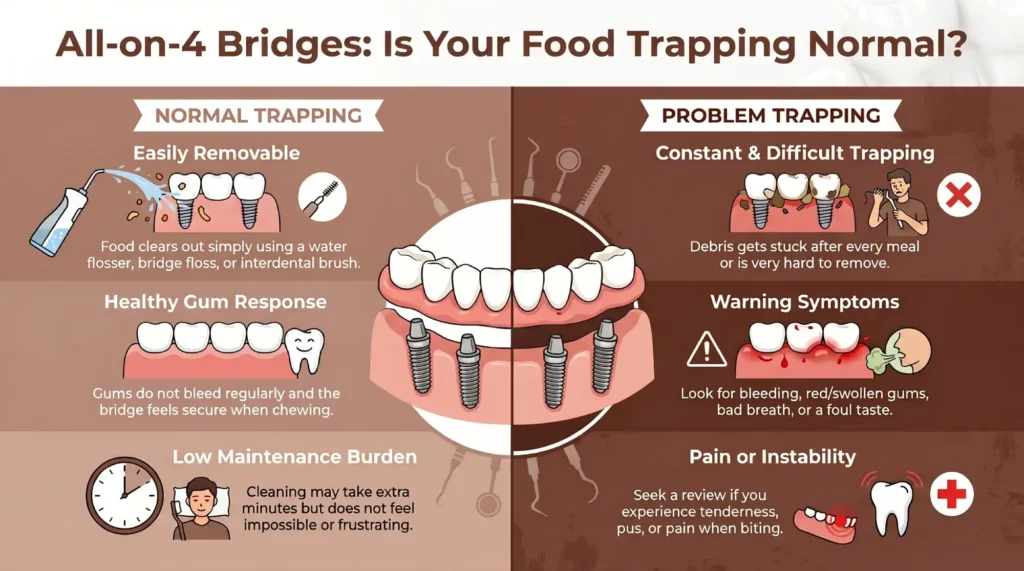
Food trapping may be normal if you can remove it with a water flosser, X-Floss, bridge floss, or an interdental brush. Your gums should not bleed regularly, the bridge should not move, and there should be no lasting bad taste or pain. A stable implant bridge should feel secure when you chew. Cleaning may take a few extra minutes, but it should not feel impossible. If you can keep the area clean and comfortable with your daily routine, that is usually a good sign.
Food trapping may need a dental review if it happens after nearly every meal or always in the same area. It may also be a concern if the food is difficult to remove, smells bad when it comes out, or makes you avoid certain foods. Constant trapping may suggest that the hygienic gap, bridge contour, gum shape, or cleaning method needs attention. We do not want patients feeling embarrassed or frustrated by this. These issues are common, and they can often be improved with the right advice.
Bleeding, red gums, swollen gums, tenderness, pain when biting, pus, bad breath, or a foul taste can be signs that the implant area needs professional care. Gum inflammation can begin before severe pain appears, so it is better to act early. If you notice these signs around your All-on-4 bridge, book an implant review. We can check the gum line, bridge fit, cleaning access, bite pressure, and implant health.
Cleaning under All-on-4 dental implants should become part of your daily routine. The goal is to remove food debris, plaque, and bacteria from the bridge surface, gum line, and underside of the prosthesis. A standard toothbrush alone is usually not enough for a fixed implant bridge. Most patients need a combination of brushing, water flossing, and special floss or small brushes. The right tools depend on your bridge shape, gum contour, hand control, and the space under the bridge.
Brush the bridge, prosthetic teeth, gum line, tongue, cheeks, and remaining natural teeth twice daily. A soft-bristled toothbrush or electric toothbrush can help clean plaque without being too harsh on the gum tissue. Use gentle pressure and focus on the area where the bridge meets the gums. A low-abrasive toothpaste is usually a sensible choice because implant bridges and prosthetic materials need gentle daily care. Brushing keeps the visible teeth clean, but it should be paired with tools that clean underneath the bridge.
A Waterpik Water Flosser or another water flosser can help flush food particles from under the implant bridge. The water stream can reach areas that a toothbrush cannot access. Many patients find this helpful after meals and before bed. Start with a comfortable pressure setting, especially if your gums are sensitive. Aim along the gum line and under the bridge, but do not blast the tissue aggressively. Your dentist or hygienist can show you the safest angle and pressure for your bridge.
X-Floss, bridge floss, super floss, or floss threaders can clean under the bridge and around implant posts. These tools are useful because they can reach plaque that water alone may not remove. It may take practice at first. Many patients feel awkward using special floss under a fixed bridge, but once the technique is shown properly, it becomes much easier. If you are unsure, bring your cleaning tools to your appointment and we can guide you.
Interdental brushes, TeePee brushes, or small implant brushes can help clean open spaces around the gum line. They are useful when there is enough space for the brush to pass gently. Do not force an interdental brush into a tight area. The wrong size can irritate the gums or make cleaning uncomfortable. The best brush should fit smoothly and clean without pressure.
If food often collects under your bridge, rinsing with water after meals can help loosen particles before they settle. This is a simple habit that can make evening cleaning easier. Antibacterial mouthwash may help some patients, but it should not replace brushing, flossing, or water flossing. Mouthwash can support hygiene, but mechanical cleaning is still the main way to remove food and plaque.
Night cleaning is very important. Food debris, plaque, and bacteria should not sit under the bridge while you sleep. A good evening routine gives the gums a cleaner environment overnight. A practical night routine may include brushing, water flossing, and targeted cleaning with bridge floss or interdental brushes. It may take a few minutes, but it is one of the best habits for long-term implant maintenance.
The best cleaning tools for All-on-4 implants are the ones that match your bridge design and that you can use every day. One tool rarely cleans every surface. A fixed implant bridge has a chewing surface, front surface, inside surface, gum line, and underside. The table below explains the common tools and how they help.
| Tool | Best use | Important note |
| Soft-bristled toothbrush | Daily cleaning of bridge, gums, and gum line | Use gentle pressure |
| Electric toothbrush | Plaque control around prosthetic teeth | Avoid pressing too hard |
| Waterpik or water flosser | Flushing food under the bridge | Start on a comfortable setting |
| X-Floss or bridge floss | Cleaning under the fixed bridge | Good for targeted cleaning |
| Floss threader | Guiding floss under hard-to-reach areas | Takes practice |
| Interdental brush | Cleaning larger spaces around implants | Must be the correct size |
| TeePee brush | Cleaning small open spaces | Do not force it |
| Antibacterial mouthwash | Extra support for bacteria control | Does not replace mechanical cleaning |
A toothbrush is excellent for the visible bridge surfaces, but it cannot always clean underneath the bridge. A water flosser can flush out food debris, but it may not remove all plaque from every contact area. Special floss and small brushes can clean targeted spaces, but they may not be suitable for every gap. This is why many All-on-4 patients use a combination of tools. A common routine is brushing, then water flossing, then using X-Floss or an interdental brush in areas that trap food.
Every implant bridge is slightly different. The size of the hygienic gap, the gum shape, the implant positions, and the underside of the bridge all affect cleaning. A tool that works well for one patient may not be right for another. At Park St Dental Practice, we can review your implant bridge and show you which tools fit safely. This is much better than guessing and buying several products that may not suit your mouth.
Some foods are more likely to get trapped under a full-arch dental implant bridge because of their size, texture, or stickiness. You may still be able to enjoy these foods, but you may need to clean carefully afterwards. If the same food causes trouble every time, take note. It may help your dentist understand where food is collecting and whether the cleaning access needs review.
Small foods can slide under the bridge and sit near the gum line. Common examples include sesame seeds, chia seeds, rice, quinoa, popcorn pieces, and small nut fragments. These foods may not hurt, but they can be annoying and may cause smell if they remain under the bridge. A water flosser is often useful for flushing out small particles.
Fibrous foods can catch around the underside of the bridge. Meat fibres, celery strings, leafy greens, pineapple, mango fibres, and herbs can wrap around small spaces near the gum line. These foods may need targeted cleaning with bridge floss or a small brush. If fibrous foods are always catching in one area, the bridge shape or cleaning access may need checking.
Sticky foods can cling to the prosthesis and become harder to remove. Caramel, toffee, sticky lollies, dried fruit, and chewing gum are common examples. Sticky foods can also pull at dental work and make cleaning more difficult. It is sensible to limit them or clean soon after eating.
Hard foods such as ice, hard lollies, popcorn kernels, and very hard nuts can cause two problems. They may trap particles under the bridge, and they can also place heavy pressure on the dental implant bridge. Dental implant bridges are strong, but they are not indestructible. Avoid using your implant teeth to bite hard objects or open packaging.
Trapped food can contribute to bad breath, gum irritation, and plaque build-up if it is not cleaned away properly. Food particles alone are not the only issue. The bigger concern is what happens when food mixes with plaque and bacteria around the gum line and implant areas. This is why cleaning under All-on-4 implants is about more than comfort. It helps protect the gums, implant posts, and bone support.
When food debris sits under the bridge, bacteria can feed on it. This can lead to plaque build-up, bacterial biofilm, bad breath, and a foul taste. The longer debris stays trapped, the more irritating it can become for the gums. Good daily cleaning interrupts this process. It helps keep the mouth fresher and reduces the chance of gum inflammation.
Gum inflammation does not always start with severe pain. Early signs may include redness, bleeding when cleaning, tenderness, swelling, or a change in smell. Some patients notice a bad taste before they feel discomfort. Do not wait for strong pain before asking for help. Early gum inflammation is usually easier to manage than a more advanced implant problem.
Peri-implantitis is inflammation around dental implants that may affect the supporting bone. It is linked with plaque control, bacteria build-up, gum health, and maintenance habits. This is one reason All-on-4 implants need regular home care and professional reviews. The aim is prevention. Keeping the bridge clean, checking the gums, and attending implant maintenance appointments help reduce risk.
Occasional bad breath after food trapping may settle after cleaning. But if a smell or foul taste keeps returning, the area should be checked. There may be plaque, trapped food, gum inflammation, or a bridge contour that is difficult to clean. A professional implant review can help identify the cause and give you a clearer cleaning plan.
If food still gets trapped even though you are brushing, water flossing, and using specialised floss, do not blame yourself. Sometimes the issue is the bridge shape, gum changes, cleaning access, or bite pressure. A dental review can help work out what is happening. The goal is to make the bridge cleanable and comfortable. If a patient struggles every day, the routine may need adjusting.
The gap under the bridge should allow cleaning, but it should not make daily life frustrating. If the space is too difficult to manage or traps food constantly, a dentist can assess whether the gap is healthy and cleanable. Sometimes the answer is better technique. Other times, the bridge contour or gum shape may need closer review.
After extractions and implant surgery, the gum tissue and jawbone can change. Gum shrinkage may make the space under the bridge larger than it felt at first. This can happen during healing or over a longer period. If food trapping has increased over time, it may be because the soft tissue has changed. An implant review can check whether the bridge still fits well.
The underside of the prosthesis can affect how food collects. If one area is bulky, rough, or hard to clean, food may catch there more often. A dentist can examine the underside, cleaning access, and gum health. This helps decide whether maintenance, adjustment, or a different cleaning method is needed.
The tools that worked at first may not always be the best tools later. Gum changes, bridge wear, or hand comfort can affect cleaning. You may need a different water flosser tip, a new floss type, a different interdental brush size, or a better angle. A dental hygiene appointment can make a big difference. We can show you exactly where food is collecting and how to remove it safely.
Bite pressure can affect how food moves under the bridge. If one side hits harder when chewing, food may be pushed into a specific area. Bite changes can also make the bridge feel uncomfortable. A bite check can help detect uneven pressure, clenching, or bruxism. If grinding is present, a nightguard or anti-clenching appliance may be recommended.
Home care is essential, but professional implant maintenance is also important. A dentist or hygienist can clean areas that are hard to reach, check the gums, assess the bridge fit, review bite pressure, and identify early warning signs. All-on-4 dental implants are a long-term investment. Regular maintenance helps protect that investment.
Many patients benefit from professional implant reviews every three to six months. The right schedule depends on gum health, plaque levels, cleaning ability, smoking, medical history, bridge design, and previous implant issues. Some patients need closer monitoring, especially if they have gum inflammation, food trapping, dry mouth, bruxism, or difficulty cleaning under the bridge.
During an implant review, we may check the gum line, bleeding, swelling, plaque, calculus, bridge fit, hygienic gap, implant posts, cleaning access, bite pressure, prosthetic wear, and signs of grinding. X-rays or a CBCT scan may be recommended if bone levels or implant support need assessment. This is not just a quick look. It is a check of the full implant system: bridge, gums, implants, bite, and hygiene routine.
Home cleaning removes daily food and plaque. Professional cleaning can remove build-up from harder-to-reach areas and help identify problems before they become painful. It also gives you a chance to improve your cleaning technique. If you feel food is constantly getting stuck, professional cleaning and guidance may make home care much easier.
You should call a dentist if food under your All-on-4 bridge is becoming difficult to manage. A small amount of food trapping may be normal, but constant trapping or symptoms can point to a problem that needs care. We would rather check the area early than wait until pain, infection, or implant complications develop.
If you live in Mona Vale or the Northern Beaches and food keeps getting stuck under your full-arch implant bridge, we can help. We provide dental implant care and can review your cleaning access, gum health, bite comfort, and long-term maintenance needs. Our focus is to help you keep your implants clean, comfortable, and functional.
Park St Dental Practice is a Dental Implant Centre in Mona Vale. We can assess full-arch dental implants, dental implant bridges, gum health, hygienic spaces, bite comfort, and professional cleaning needs. If you are considering All-on-4 dental implants, we can also discuss what daily cleaning is like before treatment, so you know what to expect.
You should book an implant maintenance visit if:
If food keeps getting stuck under your full-arch dental implants, contact Park St Dental Practice in Mona Vale. We can assess your implant bridge, check your gums, review your cleaning routine, and help you keep your implants clean and comfortable.
Food trapping is easier to manage when you have a simple routine. Use this checklist as a guide, but follow your dentist’s advice for your own bridge.
Book an implant review if food is hard to remove, smells bad, causes bleeding, or keeps getting trapped.
Yes, food can sometimes get stuck under All-on-4 dental implants because the fixed bridge usually has a small cleaning space near the gum line. This space helps patients clean around the implant posts and gum tissue.
Some food trapping is normal if it cleans out easily and does not cause pain, bleeding, swelling, bad breath, or a foul taste. If it happens constantly or is hard to clean, a dentist should check it.
You can clean under All-on-4 dental implants with a soft-bristled toothbrush, water flosser, X-Floss, bridge floss, floss threaders, and interdental brushes where suitable. The best routine depends on the bridge design.
Fixed All-on-4 implant bridges are usually cleaned at home while in place, with professional cleaning and implant reviews at the dental clinic. Some deeper maintenance may need professional care.
A smell may come from trapped food, plaque build-up, or bacteria under the bridge. If it keeps happening, book an implant review to check the gum line, bridge fit, and cleaning access.
Trapped food alone is not the only cause, but food debris and plaque left around implants can support bacteria build-up and gum inflammation. Poor cleaning over time may increase peri-implant disease risk.
See a dentist if food gets stuck after most meals, if you cannot clean it out, or if you notice bleeding, swelling, pain, bad breath, foul taste, or a loose bridge.
Food can sometimes get stuck under All-on-4 dental implants because a fixed implant bridge needs a small hygienic gap near the gum line. This can usually be managed with the right cleaning routine, including brushing, water flossing, bridge floss, interdental brushes, and regular professional maintenance. The concern starts when food is hard to remove, smells bad, causes bleeding, or comes with swelling or pain.
At Park St Dental Practice in Mona Vale, we help patients care for dental implants with practical advice, professional cleaning, implant reviews, and long-term maintenance. If food keeps getting stuck under your full-arch dental implants, contact our team. We can review your implant bridge, check your gums, assess cleaning access, and help you maintain your implants with confidence.